Their silence says nothing about you
It says their process has nobody closing it. Here is what to do on day 10 — and how to get the part that is actually missing: what the person who interviewed you thought.
Create my free accountYou had the interview. It went well, or so you thought. They said they would get back to you that week, and three have passed. You follow up, nothing comes back, and you start replaying the conversation looking for the moment you ruined it. We are not going to tell you to take care of yourself. We are going to tell you what to do on day 10.
«In most of the processes I have taken part in, I have never known why I was turned down»
If you have spent years doing your job well and months job hunting, and you have already rewritten your CV three times, this is for you.
What is really happening on the other side
Across 200,000 recruiter-initiated conversations, almost half of the formal closures were simply the role being archived: frozen, filled internally or cancelled, with nobody telling the people inside the process (Pin, 2026).
And it is not your case, it is the case: between 52% and 65% of candidates, depending on the country, leave an interview and never hear back (Greenhouse, 2024, n=2,900).
Silence is usually disorder in their process, not a verdict on you. But it leaves you without the one piece of information that would make you better.
The protocol: two touches and a date
Three steps with a date written down. The calendar is set by the interview, not by your anxiety.
- 1
Day 0 · decide who writes
On your way out, note the company, role, date and, if you have it, the address of the person who interviewed you. With that email registered in KoManao, we send the message. Without it, you write it on day 10.
- 2
Day 10 · a single message
Not the next day, not a month later. One message, from your own inbox, with one concrete question. Just one. The template is below.
- 3
Day 17 · archive it and move on
If there is no answer, you close it: archive the process as no reply and open the next one. No third message: it will not bring the information and it will cost you the afternoon.
Before you send anything, write down the three likely setbacks (no reply, a vague reply, a reply that stings) and what you will do with each. Written down in advance, none of them catches you.
The day-10 template
Copy it, change what is in brackets and send it from your own inbox, with no attachments or links. If you registered the interview in KoManao, we do this for you.
Subject: Interview on [date] · [role]
Hi [name],

this is [your name], we met on [date] for the [role] position. I do not know whether the process is still open and I do not want to push: I am only asking for one piece of information, because it helps me in the next ones. What would I have needed for a yes?

Thank you for the time you gave me in the interview, either way.

[your name]
Why wasn't it me? asks for an explanation, and explaining is uncomfortable. What would I have needed for a yes? asks for one concrete thing, and that does get answered.
What you will not get on your own
An email from you on day 10 sometimes gets answered. What almost never happens is someone calmly telling you what they saw in those forty minutes.
You register the interview with your interviewer's email and, twelve days later, the request goes out for you: one minute, no account or password, across seven criteria. The feedback comes to you.
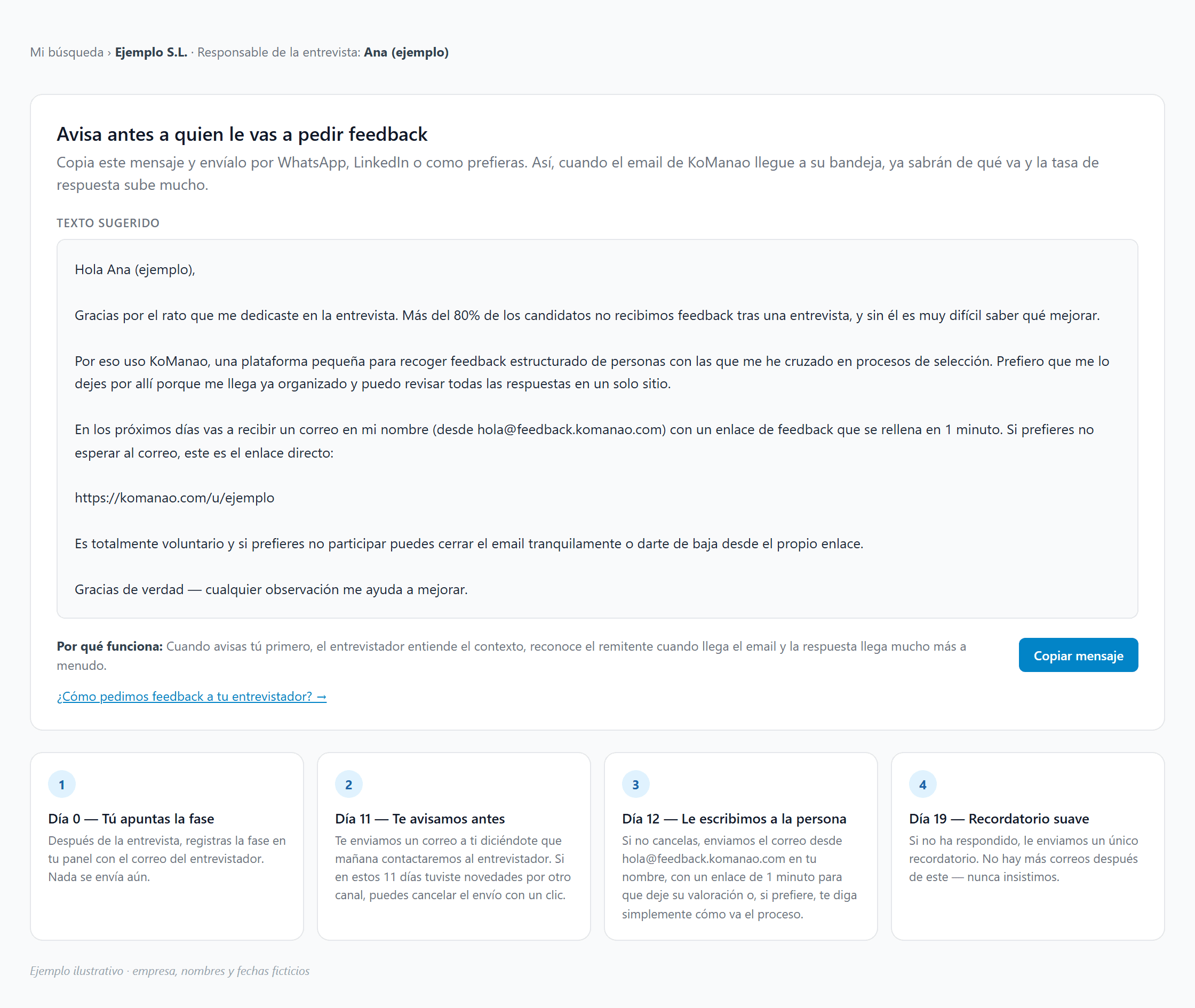
We only write to the address you register, once, for that interview, with no commercial use and one-click opt-out. If you register none, we write to nobody.
Start with your next interview
Creating an account is free and takes a couple of minutes. Start with the last interview you had.
Create my free accountThree questions we always get
- What if the interviewer sees that I use an app?
- They see a link and a question, nothing more. Asking for feedback after an interview is normal and professional: what is odd is that almost nobody does it.
- Are you going to spam the company?
- Only the address you register, once, for that interview, with one-click opt-out. We do not sell anything to that company or use their data for anything else.
- Why is it free?
- Because the link and the feedback are the heart of the project. We charge for what comes after: interpreting your results and sessions with an expert.
If you run a school or a career services team
It is a resource for your students too, and the silence is your problem before it is theirs.
Your students leave interviews without knowing what happened, and the school does not know either: employability is measured at the end, when nothing can be corrected.
With institutions it works like this: each student registers their interviews, the request goes out on its own and your team sees the pattern by cohort. And we leave you a written protocol for what to tell a student who gets no reply.
Between 52% and 65% of them, depending on the country, will get no answer (Greenhouse, 2024).
Sources
Them not getting back to you says nothing about you. What does say something is what the person who interviewed you thought, and that can be asked for. KoManao. 🌺